|
~~~~~~~~~~~~~~~~~~~~~~
Contact PCOC
Email Address
pcocwebinquiry@pcoc.net
|
|
LUXATING
PATELLAS
by
Dr. Lucy Henney and Dr. Craig Riggs, Oakland Veterinary Referral
Services, Bloomfield, Michigan
submitted
by Email Address
For
additional information on this topic, please see the website of
the Orthopedic Foundation for Animals (OFA): http://www.offa.org/ofapatlx.html |
| Patella
Luxations |
| Patellar
luxations (dislocation of the knee-cap) occur frequently in dogs
and rarely in cats. Patellar luxations can he grouped into two
main categories. First, and most commonly, is medially luxating
patellas (MLP) which are congenital (existing from birth) and
commonly affect cats and smaller breed of dogs. The second type
is laterally luxating patellas which are often the result of
trauma and can affect any pet. Lameness occurs as the patella
luxates and often resolves when it spontaneously reduces.
Lameness is often intern-intermittent and animals will learn to
reduce the patella themselves by extending the hip and the knee
together behind them. Diagnosis is made on physical examination
and may be confirmed with radiographs. Radiographs will
demonstrate the patella luxation if the patella is dislocated
-at the time the radiographs are taken. All animals with
patellar luxation can develop some degree of arthritis. |
|
|
| Anatomy
|
The patella
normally moves up and down in a groove in the lower femur bone
called the trochlear groove. In patella luxation the groove is
often shallow. This shallow groove prevents the patella from
seating deeply and predisposes it to dislocation. This results
in the luxation of the patella as the leg is used. The
quadriceps or extensor muscles of the leg are associated with
the patella. In patellar luxation, the extensor muscles are
often maligned to the inside or outside of the leg, The degree
of patella luxation is graded from I to IV depending on the
relative ease with which the patella luxates. Grade I is the
mildest and grade IV the most severe. Grade I and II patellar
luxations may be completely asymptomatic and may be incidental
findings is mature dogs and cats who have never been lame. Grade
III and IV MLP patients are usually lame. Severe cases may
develop abnormal growth of the long bones of the leg or a
nonfunctional knee. |
|
|
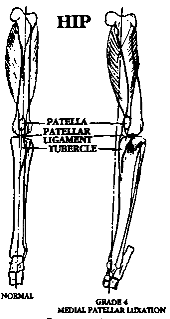
| Medially
Luxating Patellas |
|
| In media]
patella luxation, the patella (knee-cap) dislocates to the
inside of the knee. This is the most common form of patella
luxation and it is often congenital and affects both knees. one
knee may be more severely affected than the other. MLP generally
affects smaller breeds of dogs and cats. |
|
|
| Laterally
Luxating Patellas |
|
| Lateral
patellar luxation can be congenital or the result of trauma to the
knee. This condition often affects larger breeds of dogs and can
cause problems similar to MLP. In some cases the patella can
luxate both medially and laterally. Grading and recommendations
for surgery follow the same guidelines as for MLP. |
|
|
| Surgical
Correction |
|
| The
decision to perform surgery on animals with patellar luxations is
based on many factors including the degree of lameness, the grade
of patellar luxation, the age of the animal, and the presence of
concurrent problems with the knee.
As previously discussed,
some animals with lameness. often low grade MLP, which has been
present all of the animal's life, is noted on routine physical
examination without any history of lameness. in these cases,
surgery is not indicated. Arthritis will develop, whether or not
surgery is performed. Additionally, there is no increased
incidence of ligament injuries in these knees, contrary to what
was previously believed. Surgery is performed to improve function
of the leg, therefore, if the animal is not lame, surgery is not
indicated.
Grade of patellar
luxation may dictate the need for surgery. In growing animals,
severe patellar luxation may result in crippling deformity of the
leg. if the grade of patellar luxation is high (some II and all of
fit and IV), your veterinarian will likely suggest surgery as soon
as your pet can tolerate the procedure. In older animals with
higher grade patellar luxations, lameness if often present and
surgery should improve function of the leg.
Patellar luxation may
also be found in conjunction with other injuries to the knee which
require surgery, most commonly, rupture of the cranial cruciate
ligament. Often the surgeon will discuss correction of the
patellar luxation at the same time the other injury is repaired.
|
|
|
| Surgical
Techniques
|
Most surgical corrections of
patellar luxations consist of deepening the groove in which the
patella rides, removal of redundant (excess) tissues and possibly,
movement of the bone on which the patellar ligament inserts.
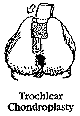
Deepening the groove (trochleoplasty)
can be accomplished in several ways, depending on the age and size
of the patient (see diagram 2). By deepening the groove, the patella
is less likely to move into an abnormal position. This is usually
combined with other techniques to maximize stability of the knee.
When the patella is
returned to its normal position, the soft tissues around it will be
loose on one side and tight on the other. The surgeon will therefore
tighten the soft tissues on the one side to hold the patella in
place and release or loosen the tissues on the opposite side.
The insertion of the
patellar ligament on the tibia or shin bone may require
repositioning. Because bone heals better than ligament, the bone is
cut, with the ligament attached, and move to a more normal location.
It is secured with two small pins. This is usually necessary for
grade III and IV MLP.
Not all cases require use
of all these techniques. Each case is individually assessed and the
appropriate combination of techniques utilized. Often, the final
decision is made at the time of surgery.
|
|
|
| Postoperative
Care |
|
| Following
surgery, the affected leg may be placed in a soft padded bandage.
This is to reduce discomfort and discourage excessive use of the
leg in the early post-operative period. The pet.is usually
hospitalized for one night after surgery. The bandage and sutures
are removed approximately 10 to 14 days after discharge.
Additional rechecks will be scheduled as needed and usually
include reassessment at 4 to 6 weeks post-operatively. Most
animals begin using the leg soon after bandage removal, but may
not reach full function for several weeks. Physical therapy may be
suggested to facilitate early use of the leg. Exercise restriction
should be enforced for 10 to 12 weeks after surgery.
As previously mentioned,
some arthritis is expected even after surgical correction of the
patellar luxation. The arthritis generally does not result in
lameness. Prognosis is favorable in cases without excessive
arthritis or growth deformities. After surgery in small breeds of
dogs and cats, use of the leg is often normal or close to it. The
prognosis for your pet will be discussed prior to surgery.
If your pet requires
surgical correction of both knees, they will generally be operated
approximately 6 weeks apart. This is allow the one leg to recover
from surgery and strengthen prior to performing surgery on the
second side. In some cases, on small dogs and cats, both knees may
be operated at the same time.
Patellar luxations
(dislocation of the knee-cap) occur frequently in dogs and rarely
in cats. Patellar luxations can be grouped into two main
categories. First, and most commonly, is medially- luxating
patellas (MLP) which are congenital (existing from birth) and
commonly affect cats and smaller breed of dogs. The second type is
laterally luxating patellas which are often the result of trauma
and can affect any pet. Lameness occurs as the patella luxates and
often resolves when it spontaneously reduces. Lameness is often
intermittent and animals will learn to reduce the patella
themselves by extending the hip and the knee together behind them.
Diagnosis is made on physical examination and may be confirmed
with radiographs. Radiographs will demonstrate the patella
luxation if the patella is dislocated at the time the radiographs
are taken. All animals with patellar luxation can develop some
degree of arthritis.
|
|
~
http://www.veterinarymall.com/info/patella.html |
|
~~~~~~~~~~~~~~~~~~~~~~
©
Copyright 2000
Pomeranian
Club of
Canada
All Rights Reserved
|